Live demo containment
Robot and motion demos need safe viewing, power planning, cable discipline and a queue position that does not trap visitors.
industry
Industrial Automation Booth Design for manufacturers and technical sales teams who need an India exhibition presence that feels premium, operationally controlled and connected to sales follow-up.
Exhibition brief
Industrial Automation Booth Design is not a generic graphics exercise. The booth has to make a technical product legible to different visitors: founders, plant heads, purchase teams, design engineers, distributors, system integrators and journalists may all approach the same stand with different questions. The page therefore treats industrial automation booth design as a product-story problem first and a fabrication problem second.
The design logic should decide what deserves a physical demo, what can live on an LED wall, what needs a cutaway or sample plinth, and what must be reserved for a private conversation. That gives the sales team cleaner routes: quick qualification at reception, short explanation at the demo zone, deeper discussion in a meeting pod, and structured capture before the visitor leaves.
Sector-specific booth thinking
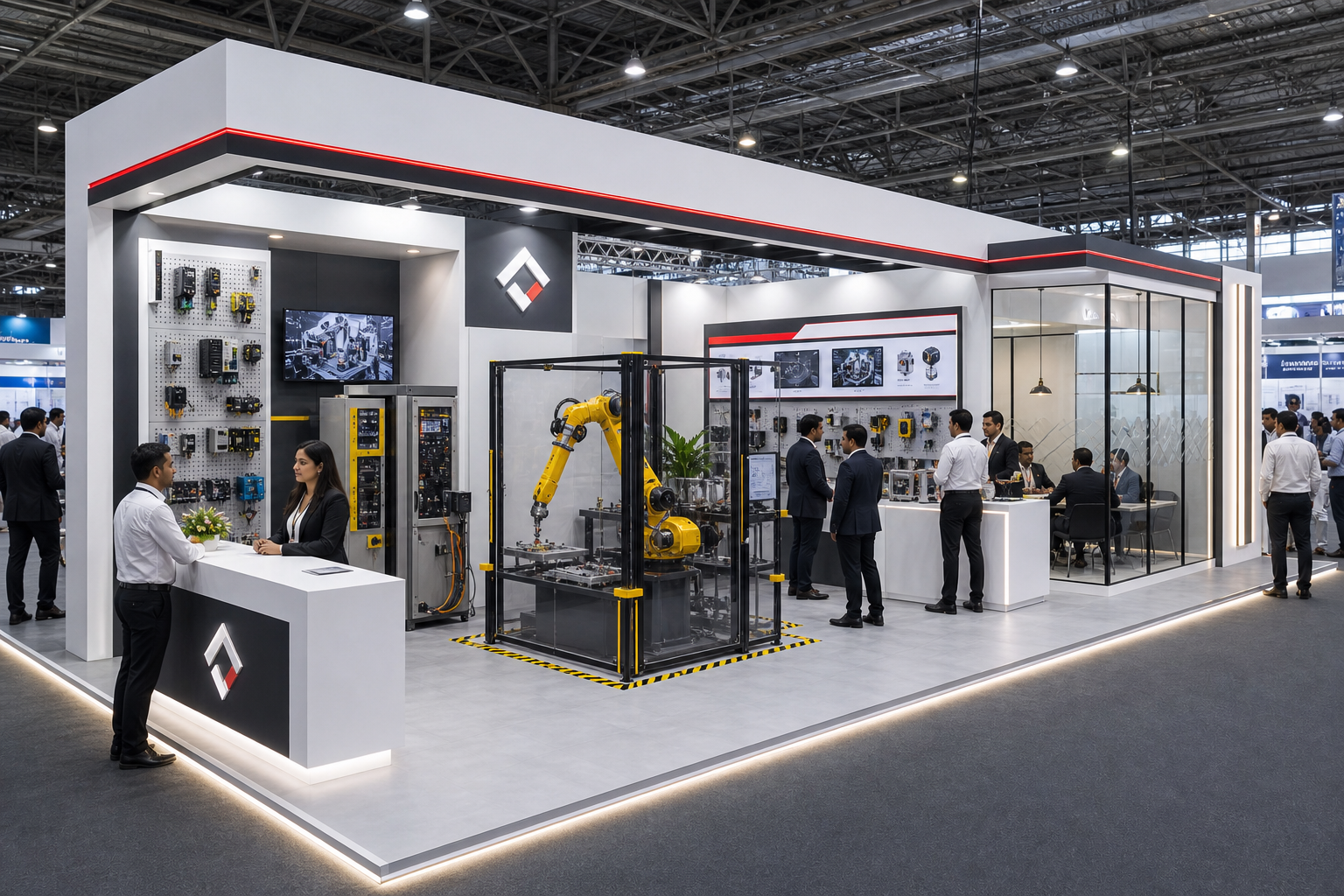
Industrial automation visitors want proof fast. They need to see the robot cell, PLC cabinet, sensor wall, machine vision demo or software dashboard behaving like a real production environment. The booth must create theatre without compromising safety or blocking the aisle. We solve this with protected demo cells, a clear explanation rail, control-system wall graphics, and meeting space close enough for engineers to pull up drawings without leaving the stand.
Robot and motion demos need safe viewing, power planning, cable discipline and a queue position that does not trap visitors.
Controls, sensors and software need layered messaging: headline, diagram, demo, then technical conversation.
Plant heads, integrators, purchase teams and operators need different proof points; the booth should route them cleanly.
Strategic fit
Industrial buyers need to understand products quickly, but they also need space for technical conversation. A industrial automation booth design project should make demos legible, protect the sales team's meeting rhythm, and separate curiosity from genuine buying intent.
The best-fit client is a manufacturer with a serious product, a sales team that needs qualified conversations, and a leadership group that wants booth spend to connect to pipeline instead of disappearing into a photo folder after the show.
Booth system
A crisp message hierarchy that lets buyers understand category, value and proof before a salesperson starts explaining.
Reception, demo, product, meeting and storage zones are planned so the stand feels open without becoming chaotic.
Lead capture is treated as part of booth design, with CardToDeal and VynDeal available for capture, routing, quotes and follow-up.
Space planning
For automation and robotics exhibitors, space planning is about safe demonstration and fast comprehension. Robot cells, motion demos, sensor walls and dashboards need viewing distance, cable control, operator access and a route for engineers to ask detailed questions.
We plan the booth so the live demo attracts attention without swallowing the whole stand. Reception qualifies visitors, the demo zone proves capability, and the meeting area handles plant, integration, procurement and distributor conversations.
Exhibition pipeline
Booth design by Quiamo, lead capture with CardToDeal, pipeline follow-up with VynDeal. Use the tools where they fit; the goal is a cleaner journey from anonymous visitor to qualified opportunity.
FAQs
For serious Indian exhibitions, begin 10 to 16 weeks before the show. Complex fabrication, imported product demos, double-decker structures and country pavilions need more time for approvals, drawings and venue coordination.
Yes. The operating model should include remote approvals, milestone reviews, artwork locks, vendor accountability, installation updates and a clear escalation path for the India team.
Quiamo can coordinate execution support and vendor management where appropriate. The positioning is not generic carpentry; it is strategy-led booth design and project coordination for manufacturers.
CardToDeal can be used at the reception desk or by sales staff to scan visiting cards and convert them into structured lead records while show context is still fresh.
VynDeal can help move exhibition leads into follow-up stages, sample requests, quotes, RFQs, opportunity tracking and sales rhythm after the event.
Talk to Quiamo
Send the basics now. The first useful conversation is usually about event, booth size, products, visitor type, timeline and what must happen after the show.